 Zenaida
Gonzalez still remembers the first time she voted.
Zenaida
Gonzalez still remembers the first time she voted.
“It was my second year in college and I’d
just turned 18. I was living in California and it was
a local election, the mayor’s race and a couple
of commissioners,” said the now 33-year-old Suntree
resident.
The daughter of an El Salvadoran mother and Cuban father,
Gonzalez said voting was something she knew not to take
for granted.
“I felt like voting was something you have the privilege
of doing as a citizen; more of a duty kind of thing,”
she said.
Since that first time, she’s taken every opportunity
available to cast her ballot. She even encouraged her
parents to become citizens so they could vote and participate
in the election process. This year is no different.
“Since I come from California, immigration and other
issues affecting Latinos are always big out there. My
parents realized that if they wanted to make changes in
those types of things, they’d have to vote,”
she said.
And with the U.S.-Mexico border and immigration issues
taking center stage in President Bush’s administration
and Congress, analysts say the nation’s growing
Hispanic population needs to flex its political muscle
– from Arizona, to Washington, to Florida.
Both of the nation’s major political parties –
Democrats and Republicans – have stepped up efforts
in recent years to court Hispanic votes. Their work paid
off in the 2004 presidential election when the number
of Hispanic votes jumped 23 percent over those cast in
2000 election, according to the Pew Hispanic Center.
Center officials said more Hispanics may take to the polls
this year based on findings by the 2006 National Survey
of Latinos conducted over the summer.
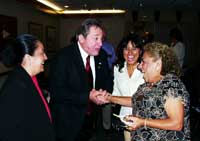 |
| Maria
DeCristofaro, Stat Rep. Mitch Needelman (R-Melbourne),
and Brevard County Commissioner Jackie Colon join
Maria Brown in a laugh during a recent campaign fundraiser
for Needelman at the Eau Gallie Yaught Club. Needelman
is seeking to be re-elected to the House District
31 seat. |
According
to the survey, more than 54 percent of Latinos surveyed
said they saw an increase in discrimination as a result
of the immigration policy debates; 75 percent of them
added that the debate politically energized them enough
to vote in the general elections on Nov. 7.
In Florida, Democrat and Republican candidates have made
a big push to include the state’s 4 million Hispanics
in campaign stops and speeches.
For instance, state Attorney General Charlie Crist, who
is running for governor on the Republican ticket, has
made frequent visits to Orlando, including as a guest
at a Spanish-language radio talk show and to participate
in a roundtable discussion with Hispanic pastors.
His Democratic opponent, Jim Davis, has specific staffers
assigned to “Hispanic outreach” as does Sen.
Bill Nelson, according to Mark Bubriski, spokesman for
the Florida Democratic Party.
“We have been working on a targeted effort specifically
directed at Hispanic Floridians in all regions of the
state, not just South Florida. We’re also spending
money in Hispanic media, especially during the last month
of the campaign,” he added.
According to one poll in September, Crist was the odds-on
favorite in the governor’s race among white and
Hispanic voters, while Davis was the top pick among African-Americans.
“I think the general election next month is very
important because of the opportunity Hispanics have to
shape the nation’s political landscape,” Bubriski
said.
“The Hispanics in Florida are a large enough population
that, in many ways, they can determine the election,”
he said.
But all of the advertising, guest appearances and handshaking
will not matter if Hispanic voters don’t show up
at the polls.
According to the latest figures, less than half of the
more than 500,000 Hispanics in Central Florida have signed
up to vote.
The first step for anyone over 18 is to register to vote.
Community organizations have started voter registration
drives. People also can contact the office of the Supervisor
of Elections.
Next up: voting in the general election on Nov. 7.
While immigration is not directly mentioned on the ballot,
voters will make a crucial decision as to who will represent
them in Washington, D.C. on this and other issues.
In Florida, voters will decide whether to keep U.S. Sen.
Bill Nelson, D-Melbourne, in office or vote in his challenger,
Republican Congresswoman Katherine Harris.
Nelson’s voting record in the Senate has included
voting for an immigration bill that would deport some
of the millions of illegal immigrants already in the U.S.
while allowing certain others, who meet strict requirements,
to request legal status. Those remaining would have to
learn English, pass a criminal background check, maintain
a lengthy record of employment, and pay all back taxes,
plus a hefty fine.
Nelson said the bill would “make the country safer,
while still meeting the needs of our economy, which depends
heavily on immigrant workers, especially in the agriculture
and service industries.
Harris, Florida’s former secretary of state, also
voted for a House bill that would toughen border security
but said in a campaign stop in South Florida in July that
she did not support the portion of the bill that makes
all illegal immigrants subject to felony charges.
She also approved an amendment stating that U.S. dollars
would not be used to tell the Mexican government the whereabouts
of volunteers with the Minuteman Project, a 7,000-strong
civilian action group patrolling the borders in California,
Texas, New Mexico and Arizona.
Additionally, Florida voters will determine if U.S. Rep.
Dave Weldon, R-Melbourne, keeps his seat against Democratic
contender Bob Bowman. Further to the south in West Palm
Beach, Hispanics could be a deciding factor in a crucial
congressional race after Rep. Mark Foley resigned over
a scandal involving an underage page in his office.
In addition to the Crist-Davis gubernatorial race, voters
also will decide on several state and local races, including
the contest between Republican incumbent Mitch Needelman
and Democratic challenger Tim Shipe for the state House
District 31 seat.
Needelman, who has held the seat for six years and been
an advocate on environmental, juvenile justice and streamlining
governmental agencies, said he has spoken with Hispanics
in Brevard on several issues.
“From what I’m hearing, they are concerned
with being able to buy a home for their kids because of
rising property costs.
Education is also a big issue as well as insurance rates.
My job is to make sure their voices are heard in Tallahassee,”
he said.
Shipe, a teacher at Melbourne Central Catholic School,
said he would provide a breath of “fresh air”
to the Statehouse and focus on the common good. He added
that Hispanics, as well as all voters, need to do their
homework before going to the polls. “I think particularly
now people need to get educated on the issues and really
look at the candidates and the type of substance they
have. They need to ask: is this person really going to
find solutions or are they parodying the (political) party?,”
he said
Gonzalez said no matter what views people have on specific
candidates, it is important to make their opinions count
by voting.
“This election is huge for Hispanics, especially
for those people who may be immigrants. Bottom line: if
you want what you want reflected in the laws in this country,
you have to vote,” she said.